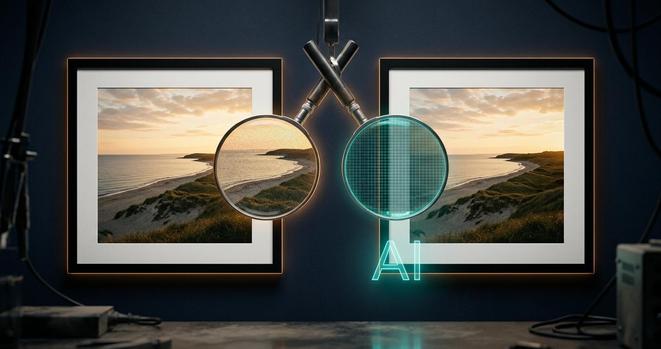
When people say: "I can always tell an AI photo" usually means "I notice the bad ones". That's what it means to me today.The usual advice is to count the fingers, check the teeth and earrings, and look for nonsense text in the background. It was good advice a couple of years ago. However, every new generator fixes exactly the "tells" people talk about.Detection that works is trained: samples of real and generated content, compared until something separates them. It beats the human eye by a long way, but a detector can only recognise what it has been shown.That is the problem with the arms race:- Stable Diffusion's founder estimated its 2022 training compute at about US$600k (256 GPUs, ~150k GPU-hours); he put DALL-E 2 at roughly 1M GPU-hours- Stanford's AI Index: ~US$78M of compute for GPT-4, ~US$191M for Gemini Ultra- Epoch AI: hardware is roughly half to two-thirds of a frontier model's cost, staff 29–49%- 2025 deepfake-detection rounds I could find: tens of millions- Running a model...
When people say: "I can always tell an AI photo" usually means "I notice the bad ones". That's what it means to me today...