[AINews] SpaceX is already a $28B/yr Neocloud
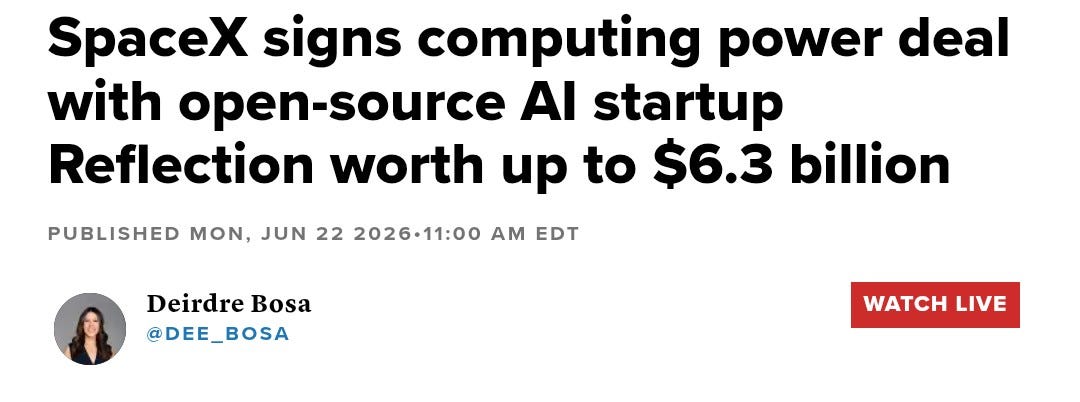
Congrats due to Baseten, who officially announced their leaked $13B Series F.Today had a smattering of midsize news across OpenAI Daybreak and Gemini Interactions and Sakana Fugu, but probably the trend to watch and hang your hat on is SpaceX’s THIRD GPU rental deal, this time with Reflection AI:Combined with the well publicized Anthropic and Google deals (hmmm… who’s missing from this customer list? Why?), one might be wondering just how far SpaceX has to go. Jamin Ball from already tallied up like for like:In Summary, $2.32B / month, >$10 / hour for Blackwells (which is a very high rate)That annualizes to $28B a year, roughly twice the current revenue of Coreweave, which is holding strong at a $60B valuation today a year after their IPO.AI News for 6/20/2026-6/22/2026. We checked 12 subreddits, 544 Twitters and no further Discords. AINews’ website lets you search all past issues. As a reminder, AINews is now a section of Latent Space. You can opt in/out of email frequencies!AI Twitter RecapOpenAI Daybreak, GPT-5.5-Cyber, and the policy/security splitOpenAI expanded its cyber stack beyond vuln discovery into remediation: OpenAI announced an expanded Daybreak program with a Codex Security plugin, the full GPT-5.5-Cyber model for trusted defenders, a Cyber Partner Program, and Patch the Planet for securing critical OSS. Follow-on posts added concrete scope: 30M+ commits scanned, 30K+ codebases covered, 70K+ reviewer-marked fixes, and 500K+ additional fixes detected automatically; major projects like cURL, Go, Python, Sigstore, and pyca/cryptography are in scope; and the plugin supports deep scans, threat modeling, patch generation, and export into existing workflows. The notable shift is from “find bugs” to closed-loop patch generation with human review.Capability claims are colliding with export-control logic: OpenAI is explicitly claiming SOTA on CyberGym for GPT-5.5-Cyber via @sama, while the public debate around Anthropic’s restricted Mythos/Fable access continued. @BlackHC asked the obvious policy question: if OpenAI’s latest cyber model is stronger, why is it not under equivalent controls? @shashj also added an important correction to the Mythos story: NSA references to “hours, not weeks” were tied to red-teaming efforts with initial access assumptions, and those red teams reportedly no longer have Mythos access. The result is a widening gap between model capability reporting and coherent governance criteria.Sakana Fugu’s orchestration release and the benchmark transparency backlashFugu reframes “model release” as learned orchestration over a model pool: Sakana introduced Fugu, presenting it as a single API that learns model selection, delegation, verification, and synthesis across multiple frontier models; Vercel quickly added Fugu Ultra to AI Gateway. The product thesis resonated with engineers who already see real systems moving toward orchestration layers: @levie called routing/orchestration a likely high-value layer, and @audreyt reported Fugu Ultra working well as a planner/advisor paired with a fast driver loop. Sakana then published a sequence of use cases—autoresearch, finance, blindfold chess, CAD—arguing that test-time coordination can beat monolithic calls on long-horizon tasks (1, 2, 3, 4).The critique was immediate: opaque baselines, missing cost accounting, and questionable reporting: The most detailed teardown came from @eliebakouch, who argues Fugu is essentially a router/classifier plus a preplanned multi-step workflow system, with several core issues: it trails Opus on SWE-Bench Pro by ~10 points, compares against anonymized “Model A/B/C,” omits token/cost reporting for best-of-N style orchestration, and should be compared against other test-time scaling setups rather than plain base models. Skepticism escalated further with @BlancheMinerva, who challenged Sakana’s trustworthiness based on prior incidents and alleged impossible performance claims in earlier work. The release still matters technically, but the discussion shifted from “is orchestration useful?” to “how should we evaluate and disclose orchestration systems?”GLM-5.2’s breakout: open-weight agents, infra adoption, and real-harness winsGLM-5.2 is emerging as the first open-weight model broadly treated as frontier-adjacent for agentic work: Multiple posts converged on the same story. Artificial Analysis put GLM-5.2 at #3 overall on GDPval-AA at 1524 Elo, behind only Claude Fable 5 and Opus 4.8, and level with or ahead of some proprietary models; they also highlighted GLM as the leading open-weight model and a strong point on the AA-Briefcase cost/performance frontier. @natolambert called it a possible “DeepSeek moment” for agents, while @AravSrinivas argued it revives serious interest in open source because it “passes the blind test” on median production knowledge work.The strongest evidence came from actual harnesses, not abstract benchmark charts: Cline tested GLM-5.2 and Opus 4.8 on a real bug in the Cline repo using the same harness and found GLM was slower and more tool-call-heavy, but cheaper ($0.41 vs $0.81) and more robust in verification: it cleaned up dead code and confirmed the production build, while Opus left type errors that passed tests. @askalphaxiv said GLM-5.2 is the first open-weights model they’ve tried that can do real autoresearch tasks, including async vs colocated RL training runs over two 8xH100 nodes. At the tooling layer, @_xjdr described promoting GLM to the default model in ncode, after spending the weekend hardening capacity, parsing tool streams, and splitting endpoints for standard vs 1M context sessions; a second thread details the surprisingly large amount of model-specific parser and harness work needed to onboard an OSS model cleanly (details).Distribution and serving velocity were unusually high: GLM-5.2 landed on AWS Marketplace, in Baseten’s library with >280 tok/s and